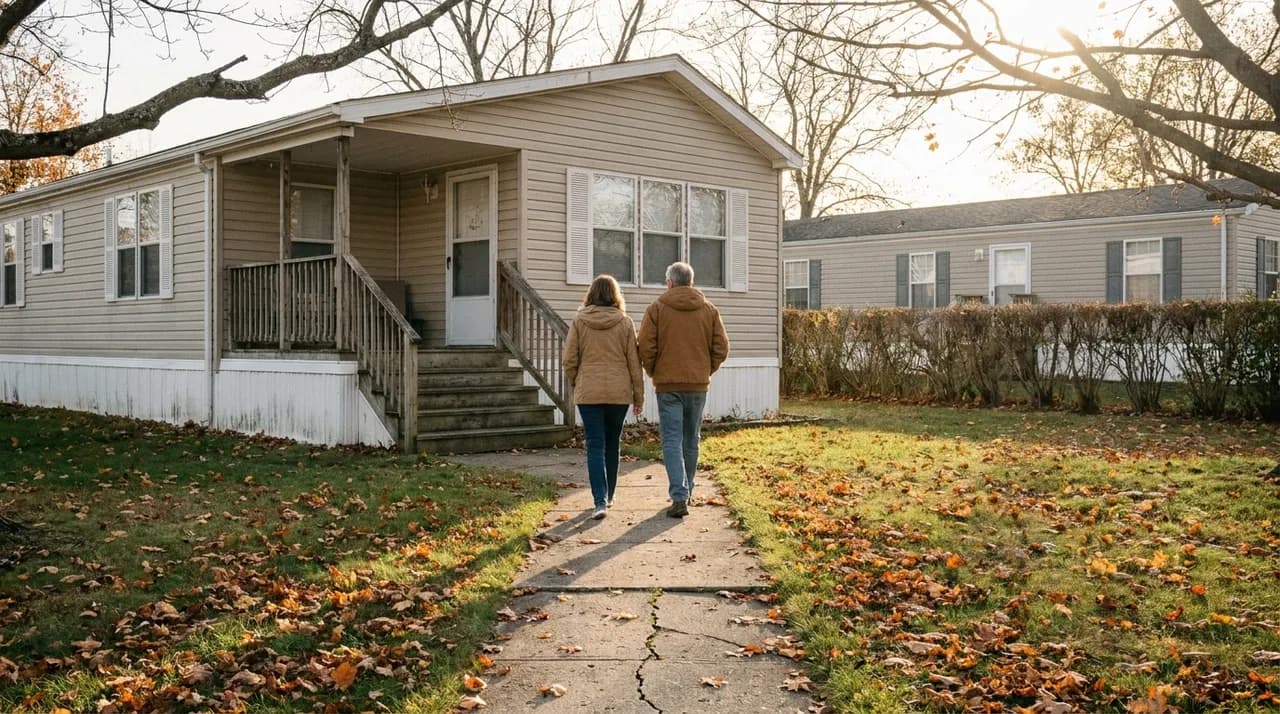
Downsizing from a New Jersey house into a manufactured home community is a specific financial trade: you convert a large stock of home equity into a much lower monthly housing cost, and you accept that you no longer own the land.
For a lot of households it is a genuinely good trade. But the version of the math people usually run is too simple, because it treats the monthly cost as a fixed number. It is not fixed. Here is how to run it properly.
Step one: the one-time number
Start with what actually lands in your account.
Proceeds from selling the house, minus the mortgage payoff, minus selling costs, minus what you pay for the manufactured home, minus moving and setup costs.
Two notes specific to New Jersey.
The sale of a used manufactured or mobile home is not subject to sales and use tax under N.J.A.C. 18:24-7.19, though the first sale of a new one is taxed on the manufacturer's invoice price. And if you finance the home rather than paying cash, expect a chattel loan, not a mortgage, because the home is personal property and the land is not yours. The CFPB found a national median chattel rate of 8.6 percent against 4.9 percent for manufactured home mortgages. Get a real quote before you assume anything.
Step two: the monthly number, both sides
Write both columns out. Do not do this in your head.
Leaving: mortgage payment if any, property taxes, homeowner's insurance, utilities on a larger building, maintenance and repairs, lawn and snow.
Taking on: lot rent, any municipal service fee, utilities, insurance on the home, maintenance on the home, and whatever the community charges for services it provides.
One New Jersey specific that surprises people. Under N.J.S.A. 54:4-1.5, a manufactured home installed in a mobile home park is not subject to taxation as real property, so you will not get a property tax bill for the home. Instead, under N.J.S.A. 54:4-1.6, a municipality may impose an annual municipal service fee on manufactured homes in a park, collected monthly by the park owner. The Philadelphia Fed's 2024 New Jersey report also notes that taxes on the land under the community are likely passed through in lot rent.
So you have not escaped the tax. You have changed how you pay it, and you have given up the ability to appeal an assessment, because the assessment is not yours.
Use your actual property tax bill for the leaving column rather than a statewide average. New Jersey's per-municipality figures are published by the Department of Community Affairs, but your own bill is the one that counts.
Step three: the part everyone gets wrong
Here is the number that decides whether this works over a twenty-year horizon.
Lot rent rises, and it compounds.
New Jersey now limits it. P.L. 2025 c.85, operative 1 March 2026, provides that a landlord shall not, over the course of a twelve-month period, increase the rent on a covered dwelling site by more than three and one half percent. That is a real protection and it did not exist before.
Now do the arithmetic on it. At 3.5 percent a year, a cost is about 41 percent higher after ten years and roughly double after twenty. That is not a prediction about your community and it is not a criticism of the cap. It is what compounding at the statutory ceiling produces, and it is the honest upper bound you should plan against.
Three further things about that ceiling.
It does not apply to a new tenancy. The law expressly permits a community to set the initial rate for a new tenancy where no tenant from the prior tenancy remains in lawful possession. Your starting lot rent is the community's number for an incoming household, not what the seller was paying. Get it in writing before you commit.
A community can petition above it, by applying to the Commissioner of Community Affairs on a showing of unanticipated cost increases or capital improvements, with a decision due within ninety days. You are entitled to notice and the supporting documentation if that happens.
Fee and rule changes need notice. Under N.J.S.A. 46:8C-2(c), a community cannot increase a disclosed fee or change a rule without specifying an implementation date at least thirty days after written notice to all tenants.
Step four: be fair to the house you are leaving
If you are going to compound lot rent forward, compound the alternative forward too. Property taxes, insurance and maintenance on a site-built house do not hold still either, and a major repair on an older house arrives in one lump rather than in monthly increments. Compare two rising numbers, not one rising number against one frozen one.
Step five: the relief programs, which genuinely matter here
Two New Jersey programs change this math for eligible households.
Senior Freeze reimburses eligible senior and disabled residents for increases in property taxes or mobile home park site fees on their principal residence. Read that again if you are over 65: the program exists specifically to offset the thing this article just warned you about. Eligibility rules are detailed, with income limits and base-year mechanics that reward applying early and staying eligible.
ANCHOR treats you as a renter. The Division of Taxation states that if you owned or rented a mobile home located in a mobile home park, you are considered a renter for purposes of the ANCHOR benefit.
Work out your eligibility for both before you decide. For a household that qualifies for Senior Freeze, the lot rent escalation risk looks materially different.
The third option most people never consider
The Philadelphia Fed report makes a point that is easy to skip past: previous research finds that the most affordable manufactured housing tenure entails owning both the home and the land.
A manufactured home on land you own is a different financial product. There is no lot rent. Under N.J.S.A. 54:4-1.5, a home affixed to land by a permanent foundation, or by a nonpermanent foundation with utility connections rendering it habitable on a permanent basis, is taxed as real property, so you get a tax bill you can appeal. And a later buyer can use conventional financing, which widens your exit.
The trade-off is that it costs more up front, at New Jersey land prices. In most of the eleven counties where this housing is concentrated, community living is the more attainable option. But if the numbers are close, run both.
What the data says, honestly
Two figures from the Philadelphia Fed's New Jersey analysis are worth sitting with.
Census block groups containing a manufactured housing community had a median household income of about $78,300 against roughly $102,400 statewide, and a homeownership rate of about 79 percent against roughly 64 percent statewide. This housing type genuinely puts ownership within reach of lower-income households, and the report concludes these communities sit in neighborhoods that are modest-income but financially stable.
But the share of housing cost burdened households in those block groups was about 36 percent, essentially identical to the statewide figure. The report notes these are neighborhood characteristics, not measurements of community residents specifically. It is still a useful corrective. Moving into a community lowers your housing cost. It does not automatically make you comfortable, and lot rent is the reason.
A worksheet you can actually fill in
Six lines. Do it on paper.
- Net proceeds from the house, after payoff and selling costs.
- Purchase price of the manufactured home, plus moving and setup.
- Line 1 minus line 2. This is your one-time gain.
- Current total monthly housing cost, from your own bills.
- Projected total monthly cost in the community, using the community's reset lot rent, not the seller's.
- Line 5 compounded at 3.5 percent for ten and twenty years, and the same exercise on line 4 using your own history of tax and insurance increases.
If line 3 is large and line 6 still works at year twenty, this is a good trade. If line 3 is modest and line 6 gets uncomfortable by year ten, it may not be, and the answer may be a different community, a smaller site-built home, or a manufactured home on owned land.
If you want help running it
We work across the eleven New Jersey counties holding nearly 88 percent of the state's manufactured housing communities, on both sides of the transaction. We can tell you what communities in your area are actually charging an incoming household, which is the number that makes or breaks this calculation.
If you are selling the house and buying into a community, we can help you find the home. If the home you are leaving is itself a manufactured home, we will either make you a cash offer or tell you to list it, whichever nets you more. More about how we work.
This article is general information about New Jersey housing costs, taxation and relief programs. It is not legal, tax or financial advice, and the illustrative arithmetic above is not a forecast of what any community will charge. Statutes, programs and eligibility rules change. Consult a New Jersey attorney, tax professional or financial adviser about your situation.
Sources: Federal Reserve Bank of Philadelphia, Manufactured Housing Communities in New Jersey: The Basics (June 2024); P.L. 2025, c.85; N.J.S.A. 54:4-1.5; NJ Department of Community Affairs, Landlord-Tenant Information Service bulletin on N.J.S.A. 46:8C; NJ Division of Taxation, Senior Freeze eligibility; NJ Division of Taxation, ANCHOR eligibility; N.J.A.C. 18:24-7.19; NJ Department of Community Affairs, property tax information